Showing posts with label Culture. Show all posts

Wednesday, 14 June 2017

Truth tries to hide by love

Sreekesh puthuvassery
Friday 16/06/2017 

" We lose ourselves in the things we love.
  We find ourselves there, too "
                                 - Kristin Martz

Love, the feeling is abundant with quotes, descriptions and comparisons by poets, writers and even by who is in love. But do you think love is eternal?. The answer is no. Love can't be a feeling that have existence neither eternal nor life long. In this article i would like to analyse love from different angles what really love itself.
We know most of the people around us especially new generation have a mentality of negligence to the personal questions. For example, what you got from your act?. Ans: it is not necessary to explain to you.  You know this is not the answer of above question. In olden days people try to analyse such questions if somebody ask. But now answers are above mentioned way. What is the reason for that?. Actually a person spending his energy and time for an act, whatever it may be, not getting any good result and the situation becomes worsen​ than actually he expected. It means he is simply a waste. This is the real reason that mind not accept this bitter truth. That's why the person reacts badly towards those kind of questions. But if he really understand what is the question and its answer he will find out the reason for his failure. That is the only way to the path of corrective action. Unfortunately negligence prepare the person to choose wrong way that certainly take him to unhappiness. So such people becomes the perfect actors in life who playing the role of a pleasant individuals whole of their life time.
Like lot of other emotion, love also an emotion. Emotions are created by hormones. Means, emotions represent the material world which is actually not eternal. Because you know the things which is created will be distroyed one day. It is a universal truth. Emotions are connected to your thoughts. If we compare thoughts are trees with so many branches, emotions are the flowers​ on it. Both are physical in nature even we can't catch or hold it. When we love a person we have sweet emotions towards him on other hand when we hate the same person we have bitter, horrible and ugly emotions towards him. So what we love actually and what is love actually?
Love is a feeling that creates mind a pleasant feeling. Love is that can make you fresh, happy and think. If there is nothing new, you can't love anything so long. It will distroy the freshness and you will not think about it sincerely from the bottom of your heart. Human interested always in something new. That is his basic character. He can't continue in the material life in same level. Desire for something new creates hopes and love to live. If it fails generates dipression. So do you think a person can love other person life long?. Can't be. Especially in male and female relationship.
Love affairs related crimes and suicide are growing day by day. Not only between youngsters but also between the elders and old people. Attraction towards the opposite sex starts in teen age. This is the worst age children​ slips to wrong path. Love someone is never a wrong thing. But what people describe like love is not divine but simply a selfish act. So it should be take care, especially girls their own life and its path. Beacuse it is own responsibility to take care own life and career. Love someone is easy if it is right or wrong decision. But there is nobody to advise how to love a person and what love really it is. Most of the children keep distance and hide things from parents while they start love somebody. Easily get angry. Until then who take care them is going to the second grade in their mind and the only the lover gets ultimate position in their mind. Actually is this love?. If it is love how other family members loves them without expecting anything from them goes to second position?. Initially love makes restless, hungerless, to see and talk with the person all the time whom they love. such situations will remain whole life?. Such feelings making that person is their life and world. Can't live without him. But what happens further?. The lovers thinks they will love each other until the end of their life. But sincerely does it happens?.  Reality that the presence of that person directly or indirectly makes feeling of happiness in other person's mind. That creates sweet emotion towards him. If the lover see the same person in worse situation, his actions making the lover angry and hatred. Then whom he/she actually loved ?. The best answer is you love yourself only none of the other. Now the person not making any pleasant feeling in your mind. Instead, about his thoughts and his presence irritating you. So you hate him. Means, through the action you proved it is only for you and for your happiness you choose that person. Now  the person can't  fulfill the need so no longer you need that person, Isn't?  Yes, that is its​ answer. So such emotions will not work so long anyway. Means love can't provide eternal or life long pleasant feeling for anybody. Because like other emotions like anger, jealous, fear, joy and surprise, love also a short term emotion.
If we regarding relationship of wife and husband also it is applicable to. Anybody loves the partner as same intensity  as they did in earlier days?. Such intensities may be last  for months or one or two years maximum. Balance all just acting. This pretending may be for the sake of the family or children etc. This is because nobody can love anybody life long. You can only love yourself life long. Why so happens? How can we avoid situation?. The actual root of the problem is love means the bitter truth of loving oneself only. If you break the concept you can love others​ life long which is essential for husband and wife relationship. Even though it is not perfect idea that can't provide you 100% pleasant feeling whole life. But atleast a greater extent to. So what is that concept. If you want to love anything, you should dissolve in to it. Means, if the partners sacrifice completely their interests and desires for other and join, support and accept partner interest and desires their will remain the happiness and freshness in the life. This will happen only when both are doing the same only. If one have ruling mentality over the other will not work this idea. That will makes you an actor to play the role or pretend infront of your partner to show that you loves him/her so much.
In this way if we consider the grade of love, Parents love is the greatest​ one. That love is free from any possessiveness and don't expect from you anything. They burnt out their life for children. Sacrificing their own desires for them. Their is no complaint for them if you do or not your duties towards them. Internally all the individuals​ desires their own ultimate freedom. Nobody want to be in any bonds that makes barrier to their ultimate happiness even that bonds as daughter, son, wife, husband, brother or sister whatever it may be. But because of some reasons they continues in the container of such relationships. Only the parents sacrificing uncontitionally all of their desires and finding out their happiness in children happiness. So basically if we thinks the most beautiful love is from the parents. That is the same reason it is telling divine. Even not together with and always see or talk, you don't have any doubt your brother or sister loves you. Reason for the real problem, you  the one define the love or approaching it with a prejudice mentality.
Is love is divine?. Some tells love is God. We understand it is just an emotion create by hormone related thoughts and it is not eternal. So how can be it divine?. We can't reach such conclusion even someone trying to find foolish justification like the list of things god provide for  you. we don't know love is God. However what we know at least dog is love. Something like spelling mistake. Some times people tells i love my family and i will die for the family. But for any reason cracks happen in the family relationships possibly changes this opinion. This is happen in case of lovers and even  husband and wife relationships. Reason for divorces​ and remarriages. So any of the above relation can maintain warmth of life long love. Because reality you love yourself not others.
Why static pleasure situation not possible? Does it possible in any way?.  Actually in material life you can't maintain your continuous state of love and pleasure. Because your happiness depends other living or non living things. You may notice most of the people don't have time to spend with their friends, families and relatives. But hey have enough time to spend with their smart phones. Why?. Because it gives new ideas, thoughts and happiness each time you use. So people think their bondage circle can't provide such level of happiness to their mind. So intentionally or unintentionally they like to get detach from such circles.  But these pleasures will be remain same level until it can provide freshness to your mind in the limit of your bandwidth. When repeatation start you will be get bore from those gadgets.
So in conclusion, love is an emotion makes pleasure to your mind. If it is dependable can't be provided stable happiness. Their dies the love. So if your happiness independent of people and things only will remains life long. That is possible when you detached from all physical relationships with living and non living things, when you have no desire to anything. When you start to dissolve in you the real static feel of pleasure starts. That is what the gauthama Buddha and so many other yogis did.
Share:

Tuesday, 16 May 2017

The Caste System of Hindu Society

The Caste System of Hindu Society

By Pankaj Jain, Ph.D.

Varna vyavastha (literally, the class system) remains one of the most interesting and debatable topics in the study of Vedic culture. Since the Vedas remain an unraveled mystery even today due to the archaic Sanskrit in which they were composed, much of the ancient social history is derived from the extrapolation from the later history of Indian society. While most of the modern scholarship on this issue applies Marxist and Weberian themes to interpret this, I endeavor to take a fresh approach to demonstrate some of the lesser-known aspects of this system.

The Original System

The varna system illustrates the spirit of comprehensive synthesis, characteristic of the ancient Indian mind with its faith in the collaboration of races and the cooperation of cultures. Paradoxical as it may seem, the system of varna was the outcome of tolerance and trust. Though it may now have degenerated into an instrument of oppression and intolerance and tends to perpetuate inequality and develop the spirit of exclusiveness, these unfortunate effects were not the central motives of the varna system. The system of varna insisted that the law of social life should not be cold and cruel competition, but harmony and co-operation. Society should not be a field of rivalry among individuals. The varnas were not allowed to compete with one another. Varna divisions were based on individual temperament, and which were not immutable. Originally varnas were assigned to people based on their aptitude and qualities, but in later periods they were assigned based on birth. However, there are a number of exceptions in the entire period that shows the flexibility of the system.

There were four varnas: brahmin, ksatriya, vaisya and sudra. The basic idea was division of labor in the society. Brahmin was defined as brahman nayati iti brahmin. People who preached spiritual teachings to the society and lived spiritual lives were called brahmins. Ksatriya was defined as kseeyate traayate iti ksatriya. These were the people who protected the society against external attacks and maintained internal order. Vaisya was defined as visati iti vaisya. Businessmen, traders and farmers came under this category. Sudras were the people engaged in services. Carpenters, blacksmiths, goldsmiths, cobblers, porters etc., fell under this category. This system ensured that the religious, political, financial and physical powers were all separated into four different social classes. Due to this fair separation of political and intellectual powers, ancient Indian society could not turn itself into a theocratic or autocratic society.

In the beginning, there was only one varna in the ancient Indian society. “We were all brahmins or all sudras,” says Brhadaranyaka Upanisad (1.4, 11-5, 1.31) and also Mahabharata (12.188). A smrti text says that one is born a sudra, and through purification he becomes a brahmin. According to Bhagavada Gita, varna is conferred on the basis of the intrinsic nature of an individual, which is a combination of three gunas (qualities): sattva, rajas, and tamas. In the Mahabharata SantiParva, Yudhisthira defines a brahmin as one who is truthful, forgiving, and kind. He clearly points out that a brahmin is not a brahmin just because he is born in a brahmin family, nor is a sudra a sudra because his parents are sudras. The same concept is mentioned in Manu Smrti. Another scripture Apastamba Dharmasutra states that by birth every human being is a sudra. It is by education and upbringing that one becomes ‘twice born’, that is, a dvija.
Manu sums up the relative status and functions of the varnas in the following verse of Manu Smrti: “The brahmin acquires his status by his knowledge, the ksatriya by his martial vigor, the vaisya by wealth; and the sudra by birth alone.” In the Bhagavada Gita, 4.13, Krsna says: “The fourfold varna has been created by Me according to the differentiation of guna (qualities).”
In Bhagavada Gita 18.41, Krsna states: “The devotees of the Lord are not sudras; sudras are they who have no faith in the Lord whichever be their varna.” Mahabharata says that a wise man should not slight even an outcaste if he is devoted to the Lord; he who looks down on him will fall into hell. SantiParva, Mahabharata also says that there is no superior varna. The universe is the work of the Immense Being. The beings created by him were only divided into varnas according to their aptitude.

Bhagavada Gita also says, “Of brahmins, ksatriyas and vaisyas, as also the sudras, O Arjuna, and the duties are distributed according to the qualities born of their own nature.” According to the Hitopades, all mankind is one family. Manu Smrti (11.157) says, “Just as a wooden toy elephant cannot be a real elephant, and a stuffed deer cannot be a real deer, so, without studying scriptures and the Vedas and the development of intellect, a brahmin by birth cannot be considered a brahmin.”

In my opinion, all the above quotations and references point out that the varnas were designated to a person based on one’s aptitude, quality, mental state and characteristic. Although birth or parentage may have played an important role in the later times, the original system seems to be based on the quality of a person rather than on birth alone. Even when the varna was ascribed based on birth, there are a number of examples from the mythology and history of ancient India to demonstrate the flexibility and mobility among the varnas.

Vyäsa, a brahmin sage and the most revered author of many Vedic scriptures including the Vedas, Mahabharata, Bhagavada Gita and Bhagavata Purana, was the son of Satyavati, a sudra woman. Vyäsa’s profound knowledge of the Vedic wisdom established him as a brahmin even though he was born of a sudra mother. Vyäsa’s father, Päräsara, was also a son of a candala woman and yet was considered a brahmin based on his Vedic wisdom. Another popular Vedic sage, Välmiki was initially a hunter. He came to be known as a brahmin sage on the basis of his profound knowledge of the scriptures and his authorship of the Rämäyana. According to Rig Veda (IX.112.3), the poet refers to his diverse parentage: “I am a reciter of hymns, my father is a physician and my mother grinds corn with stones. We desire to obtain wealth in various actions.” Sage Aitareya, author of Aitareya Upanisad, was born of a sudra woman. Vasishtha, son of a prostitute, was established as a brahmin and Rig Veda book VII is attributed to him. In Chandogya Upanisad, the honesty of Satyakäma establishes his brahminhood, even though his ancestry is unknown as he is the son of a maidservant. Visvamitra, born in a ksatriya family becomes a sage, and hence a brahmin, based on his asceticism. Some Rig Veda hymns are attributed to him. The priest Vidathin Bhärdväja became a ksatriya as soon as he was adopted by King Bharata and his descendents were the well-known Bharata ksatriyas. Janaka, a ksatriya by birth, attained the rank of a brahmin by virtue of his ripe wisdom and saintly character and is considered a rajarishi (king-sage). Vidura, a brahmin visionary, who gave religious and moral instructions to King Dhrtarashtra, was born to a woman servant of the palace. His varna as a brahmin was determined on the basis of his wisdom and knowledge of scriptures. The Kauravas and Pandavas were the descendants of Satyavati, a fisher-woman, and Vyäsa, a brahmin. In spite of this mixed heredity, the Kauravas and Pandavas were known as ksatriyas on the basis of their occupation. Ajamidha and Puramidha were admitted to the status of the brahmin class, and even composed Vedic hymns. Yaska, in his Nirukta, tells us that of two brothers, Santanu and Devapi, one becomes a ksatriya king and the other a brahmin priest. Kavasa, the son of the slave girl Ilusa, becomes a brahmin priest. The Bhagavata Purana tells of the elevation of the ksatriya clan named Dhastru to brahminhood. In the later Vedic times, Chandragupta Maurya, originally from the Muria tribe, goes on to become the famous Mauryan emperor of Magadha. Similarly, his descendant, King Asoka, was the son of a maidservant. The Sanskrit poet and author, Kalidasa is also not known to be a brahmin by birth. His works are considered among the most important Sanskrit works. In the medieval period, saint Thiruvalluvar, author of ‘Thirukural’ was a weaver. Other saints such as Kabir, Sura Dasa, Ram Dasa and Tukaram came from the sudra class also. Many of the great visionaries in modern India were not brahmins by birth but can be regarded as brahmins by their life-styles and teachings: Mahätmä Gändhi, Swämi Vivekänada, Sri Aurobindo, Maharishi Mahesh Yogi, Swämi Chinmayänanda etc.
Misconceptions about the Varna System

Heterodox ideologies such as Jainism and Buddhism have criticized the notions of varna-based svadharma (one’s own duty), which inspired Arjuna to indulge in the Mahabharata war. Since Arjuna was a ksatriya, he was motivated to follow his duty of a warrior by Krsna.

Unfortunately, the original system is often either overlooked or misinterpreted. Let us examine some of the main concerns expressed about the varna system.

· Inequality: Does the varna system treat human beings unequally, with the brahmins at the top of the hierarchy and the sudras at the bottom? This is a common observation about the system which is based on the modern caste system rather than the ancient varna system. It is rarely observed that the social hierarchy is not just limited to Hinduism but it stays intact in any Indian religious society; Buddhists, Jainas, Sikhs, Christians and Muslims have their own caste hierarchies and restrictions. Even western societies have their own classes and groups. Thus, it is indeed a social phenomenon, which is not just limited to Hinduism or India. J. Muir has provided numerous passages from ancient Indian texts to demonstrate the equality of varnas.

Rig Veda II. 33. 13 speaks of “our father Manu” (pita nah). Note that all of mankind is described as having a single ancestor.

Taittareya Brahmana II.3.8.1. It describes the process of creation of human beings by Prajapati as follows: “... he reflected, after that he created men. That constitutes the manhood of men. He, who knows the manhood of men, becomes intelligent. Mind does not forsake him.”

Satapatha Brahmana VII.5.2.6. This passage describes the process of creation of human beings by Prajapati as follows: “He formed animals from his breath, a man from his soul, a horse from his eye, a bull from his breath, a sheep from his ear, a goat from his voice.” It is worth noting that here too the various objects of creation are being correlated to various parts of the body of Prajapati, as in the Purusa Sukta.

Brhadaranyaka Upanisad I. 4. 11-15. These passages describe the successive creation of the four varnas, in contrast to their simultaneous creation in the Purusa Sukta. Just as in the case of Manu where all of humanity is traced to a single parent, here all of humanity is traced to a single homogeneous class, to begin with.

Visnu Purana VIII. 138-140. According to this account when the Eden-like existence ceased: “At this juncture the perfect mind-born sons of Brahma, of different dispositions, who had formerly existed in the Satya age, were reproduced in the Treta as brahmins, ksatriyas, vaisyas, sudras, and destructive men.” This means that the varna system characterises human life after the ‘fall’, as it were. It is a post-Lapsarian phenomenon. The development of ‘castes’ here represents a falling away from an earlier ideal condition, in which there were no varnas.

In Bhagavada Gita, it is clearly mentioned that sudra and women can achieve the liberation and it is not just limited to any one high caste.

Upanisads and other Vedic scriptures have mentioned at many places that the same Brahman exists in all the living beings and hence all are equal.

Mahabharata (III.216.14-15) mentions that a sudra can become brahmin by engaging in self-control, truth and righteousness.

H. T. Colebrooke, one of the early Sanskrit scholars wrote, “ Daily observation shows even the brahmin exercising the menial profession of a sudra. It may be received as a general maxim, that the occupation, appointed for each tribe, is entitled merely to a preference. Every profession, with few exceptions, is open to every description of persons; and the discouragement, arising from religious prejudices, is not greater than what exists in Great Britain from the effects of Municipal and Corporation laws.”

· Svabhäva by birth: In the varna system, one’s svadharma is based on one’s svabhäva. But how can svabhäva be fixed by birth? Is it a changeable substance? This debate is not fully resolved even by today’s geneologists. According to the recent research, genes are much more responsible in fixing one’s nature than they are given credit for. As more researches unfold, this mystery will unravel whether one’s svabhäva is fixed based on one’s birth or it can be changed by one’s training.

· Coercion: Did the varna system deny the basic right to choose one’s profession? Was one forced to perform one’s svadharma even against one’s call of conscience, e.g., Krsna motivates Arjuna to fight because he was born as a ksatriya? In the same war, there were many warriors who did not qualify fully as ksatriya by birth and still were fighting, e.g., Drona, Krpa, Asvatthämä, Karna, Bheeshma etc. Krsna did not ask Arjuna to fight just because he was born as a ksatriya but convinced him based on many other arguments. Whatever coercion may exist in the society could be argued as a social discipline. In the practical world, there would be complete chaos and disaster if the individuals stopped performing their duties. A well-balanced society definitely needs warriors, merchants, teachers and laborers. Hence, instead of one’s unrestrained rights, one’s duties are given more importance.

Conclusion

Varna system is one of the most debatable phenomena of India and is tarred with many controversies. However, on a deeper analysis one finds that the basic need for this system was simply to ensure a healthy and flexible society unlike the one which has been rigidified due to the colonial misinterpretation and mistreatment of varnas, resulting in the castes as we find them in the present day India . The original varna system was quite flexible in which one’s varna could be changed based on one’s skill and was not fixed as is often understood.

References
1. Sarvepalli Radhakrishnan, The Hindu View of Life,(HarperCollins, 1998)
2. Padmanabh S Jaini, “Values in comparative perspective: Svadharma versus Ahimsä”, Collected Papers on Buddhist Studies, (Motilal Banarasidas, 2001)
3. J Muir, Original Sanskrit Texts, (Delhi, Oriental Publishers, 1972)
4. Steven Pinker, The Blank Slate: The Modern Denial of Human Nature, (Viking, 2002)
5. Nicholas B Dirks, Castes of Mind: Colonialism and the Making of Modern India, (Princeton University Press, 2001)
6. Arvind Sharma, Classical Hindu Thought, (Oxford University Press, 2000)

Share:

Saturday, 14 January 2017

In the land of tigers by sreekesh puthuvassery


SOME INTERESTING FACTS ABOUT TIGERS

The tiger (Panthera tigris) is the largest cat species, most recognisable for their pattern of dark vertical stripes on reddish-orange fur with a lighter underside. The species is classified in the genus Panthera with the lion, leopard, jaguar and snow leopard. Tigers live alone and aggressively scent-mark large territories to keep their rivals away. They are powerful hunters that travel many miles to find prey.A hungry tiger can eat as much as 60 pounds (27 kilograms) in one night, though they usually eat less.
Males have a prominent ruff or collar, which is especially pronounced in the Sumatran tiger.Tigers are territorial and generally solitary but social animals, often requiring large contiguous areas of habitat that support their prey requirements.
BENGAL TIGER
(Panthera tigris tigris)
 
TYPE: Mammals
DIET: Carnivores
AVERAGE LIFE SPAN IN THE WILD: 8 to 10 years
SIZE: Head and body, 5 to 6 ft; tail, 2 to 3 ft
WEIGHT: 240 to 500 lbs
SIZE RELATIVE TO A 6-FT MAN:

The Bengal tiger is also known as the Indian tiger, as it found in scattered (now rather isolated) pockets throughout India. There are also Bengal tigers found in Indonesia, Thailand, Vietnam, Nepal, Bhutan, and along the eastern coast of China. The climate here is temperate to tropical and very wet, with the tigers thriving in mangrove forests, grasslands, and deciduous forests.
An average male Bengal tiger weighs around 500 pounds (220 kilograms) stands 36 inches high at the shoulder, measure ten feet from the tip of their nose to end of their tail and has a head that is 16 inches long and 10 inches wide and pug marks that are seven inches across. Females are generally about a foot shorter and 100 pound lighter than males. The largest one on record, according to the Guinness Book of Records, was shot in Utter Pradesh on November 1967. It was 10 feet 7 inches long and weighed 857 pounds
The Bengal will hunt water buffalo, hunting ground, covering up to 50 square kilometers (20 sq mi) in a single night’s hunt. The Siberian can cover twice that.
Despite their fearsome reputation, most tigers avoid humans; however, a few do become dangerous maneaters. These animals are often sick and unable to hunt normally, or live in an area where their traditional prey has vanished.
Females give birth to litters of two to six cubs, which they raise with little or no help from the male. Cubs cannot hunt until they are 18 months old and remain with their mothers for two to three years, when they disperse to find their own territory.A tiger's roar can be heard as far as two miles away
.
INDOCHINESE TIGER
 
The Indochinese tiger is found in Myanmar, Cambodia, Vietnam, Thailand, Malaysia and Laos. They are smaller than Bengal tigers and have different stripping patterns. They measure 2.84 meters from the end of their nose to the tip of their tail and weigh an average of 195 kilograms. There are between 250 and 600 of them. Indochinese tigers are regarded as more elusive than their Indian cousins. The tigers in Thailand are considered the most secretive of all.
 

SIBERIAN TIGER
(Panthera tigris altaica)

Status: Endangered
Type: Mammal
Diet: Carnivore
Size: 10.75 ft (3.3 m)
Weight: 660 lbs (300 kg)
Size relative to a 6-ft (2-m) man:
 
Siberian Tiger, which is also known as Amur, Manchurian, Altaic, Korean, or North China tiger. It is the largest tiger subspecies and can be found only in the protected region of Amur-Ussuri, Primorsky Krai and Khabarovsk Krai in eastern Siberia.it can weigh up to 800 pounds.
Siberian tiger average 3.14 meters (10 feet, 4 inches) in length (from nose to tip of tail), stand 1 to 1.1 meters (39 to 42 inches) at the shoulder and weigh 265 to 305 kilograms (585 to 676 pounds). A large male can measure four meters (13 feet) from tail to nose and weighs 362 kilograms (800 pounds).
The Siberian tiger’s natural habitat is the much, much colder areas to the north. The handful that still exist in the wild can mostly be found in the chilly forests of Eastern Russia, with some in the northernmost parts of China and Korea. In stark contrast to the more temperate habitats of its cousins, the Siberian tiger thrives in coniferous and birch forests where the temperatures can reach as low as -45° Celsius (-50 F).
The differences in habitat mean that the Siberian tiger has developed a much thicker, heavier coat than the Bengal. They also tend to have thick fat stores along their sides and belly that help to keep them insulated against the below-freezing temperatures.
There are also differences in color that developed from their different habitats. The Siberian tiger is the lightest of all tiger subspecies, with their coats tending to be a much paler orange than their southern cousins. The stripes of a Siberian tiger are brown instead of black, but all tigers share the trait of having completely unique stripe patterns, much like our fingerprints.
Habitat differences also lead to a different diet, though both tiger subspecies are easily capable of single-handedly taking down prey that is much, much bigger than they are. The Siberian tiger tends to hunt creatures like elk and deer, but has been known to kill and eat bears as well as smaller game.
Siberian tigers can range over 400 square miles. Male Siberian tigers generally range across an area of 150 to 225 square miles. Females range cover a slightly smaller area. Siberian tigers like to attack their prey from behind.Siberian tigers have long memories. Offspring of a mother killed by poachers were still agitated as adults whenever they came in close contact with human males. Males sometimes live only six or seven year as they die in competition for mates and territory.
Tigers grimace when they sniff scents found in their territory. Known as flehmen behavior, the facial movement helps expose the scent to the sensory-cell-covered vomeronasal organ behind the palate. This behavior is usually seen in areas where other cats have sprayed their scent. Siberian tigers sharpen their claws by standing on their hind legs and raking them downwards in the bark of a tree.

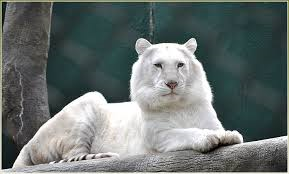
WHITE TIGER
 
The white tiger is a pigmentation variant of the Bengal tiger, which is reported in the wild from time to time in the Indian states of Assam, West Bengal and Bihar in the Sunderbans region and especially in the former State of Rewa.[1] Such a tiger has the black stripes typical of the Bengal tiger, but carries a white or near-white coat.
The white Bengal tigers are distinctive due to the color of their fur. The white fur caused by a lack of the pigment pheomelanin, which is found in Bengal tigers with orange color fur. When compared to Bengal tigers, the white Bengal tigers tend to grow faster and heavier than the orange Bengal tiger. They also tend to be somewhat bigger at birth, and as fully grown adults. White Bengal tigers are fully grown when they are 2–3 years of age. White male tigers reach weights of 200 to 230 kilograms and can grow up to 3 meters in length. As with all tigers, the white Bengal tiger’s stripes are like fingerprints, with no two tigers having the same pattern. The stripes of the tiger are a pigmentation of the skin; if an individual were to be shaved, its distinctive coat pattern would still be visible. For a white Bengal tiger to be born, both parents must carry the unusual gene for white colouring, which only happens naturally about once in 10,000 births.

SIBERIAN WHITE TIGER

The existence of white Siberian tigers has not been scientifically documented, despite occasional unsubstantiated reports of sightings of white tigers in the regions where wild Siberian tigers live. It may be that the white mutation does not exist in the wild Siberian tiger population: no white Siberian tigers have been born in captivity, despite the fact that the subspecies has been extensively bred during the last few decades (with much outbreeding between the different Siberian lineages for purposes of conservation genetics); a recessive allele should occasionally turn up in a homozygous state during such breeding, and in this particular case yield white tigers from normally-colored parents, but no such animals have been reported.
The famous white Siberian tigers found in captivity are actually not pure Siberian tigers. They are instead the result of Siberian tigers breeding with Bengal tigers. The gene for white coating is quite common among Bengal tigers, but the natural birth of a white Bengal tiger is still a very rare occasion in the wild, where white tigers are not bred selectively.
The white tiger is not considered a tiger subspecies, but rather a hybrid mutant variant of the existing tiger subspecies. If a pure white Siberian tiger were to be born, it would therefore not be selectively bred within the tiger conservation programs. It would, however, probably still be selectively bred outside the program in an effort to create more white Siberian tigers.

STRIPELESS WHITE TIGER
 
An additional genetic condition can remove most of the striping of a white tiger, making the animal almost pure white. One such specimen was exhibited at Exeter Change in England in 1820, and described by Georges Cuvier as "A white variety of Tiger is sometimes seen, with the stripes very opaque, and not to be observed except in certain angles of light."[3] Naturalist Richard Lydekker said that, "a white tiger, in which the fur was of a creamy tint, with the usual stripes faintly visible in certain parts, was exhibited at the old menagerie at Exeter Change about the year 1820.
The modern strain of snow white tigers came from repeated brother–sister matings of Bhim and Sumita at Cincinnati Zoo. The gene involved may have come from a Siberian tiger, via their part-Siberian ancestor Tony. Continued inbreeding appears to have caused a recessive gene for stripelessness to show up. About one fourth of Bhim and Sumita's offspring were stripeless. Their striped white offspring, which have been sold to zoos around the world, may also carry the stripeless gene. Because Tony's genome is present in many white tiger pedigrees, the gene may also be present in other captive white tigers. As a result, stripeless white tigers have appeared in zoos as far afield as the Czech Republic (Liberec), Spain and Mexico. Stage magicians Siegfried & Roy were the first to attempt to selectively breed tigers for stripelessness; they owned snow-white Bengal tigers taken from Cincinnati Zoo (Tsumura, Mantra, Mirage and Akbar-Kabul) and Guadalajara, Mexico (Vishnu and Jahan), as well as a stripeless Siberian tiger called Apollo.
Genetics
A white tiger's pale coloration is due to the lack of the red and yellow pigments that normally produce the orange color.[6] This had long been thought to be due to a mutation in the gene for the tyrosinase enzyme. A knockout mutation in this gene results in albinism, the inability to make either pheomelanin or eumelanin, while the consequence of a less severe mutation in the same gene is the cause of a selective loss of pheomelanin, the so-called Chinchilla trait. The white phenotype in tigers had been attributed to this Chinchilla mutation in tyrosinase, and some publications prior to the 1980s refer to it as an albino gene for this reason.[citation needed] However, genomic analysis has demonstrated instead that a mutation in the SLC45A2 gene is responsible. The resultant single amino acid substitution in this transport protein, by a mechanism yet to be determined, causes the elimination of pheomelanin expression seen in the white tiger. This is a recessive trait, meaning that it is only seen in individuals that are homozygous for this mutation.[6] Inbreeding promotes recessive traits and has been used as a strategy to produce white tigers in captivity.
The stripe color varies due to the influence and interaction of other genes. Another genetic characteristic makes the stripes of the tiger very pale; white tigers of this type are called snow-white or "pure white". White tigers, Siamese cats, and Himalayan rabbits have enzymes in their fur which react to temperature, causing them to grow darker in the cold. A white tiger named Mohini was whiter than her relatives in the Bristol Zoo, who showed more cream tones. This may have been because she spent less time outdoors in the winter.[7] White tigers produce a mutated form of tyrosinase, an enzyme used in the production of melanin, which only functions at certain temperatures, below 37 °C (99 °F). This is why Siamese cats and Himalayan rabbits are darker on their faces, ears, legs, and tails (the color points), where the cold penetrates more easily. This is called acromelanism, and other cats breeds derived from the Siamese, such as the Himalayan and the snowshoe cat, also exhibit the condition.[8] Kailash Sankhala observed that white tigers were always whiter in Rewa State, even when they were born in New Delhi and returned there. "In spite of living in a dusty courtyard, they were always snow white."[9] A weakened immune system is directly linked to reduced pigmentation in white tigers.
 
EXTINCT TIGERS FAMILY IN THE WORLD


BALI TIGER
 
 
This tiger, the scientific name of which is Panthera tigris balica, lived only on Bali island in Indonesia.
It was the smallest of all of the tiger subspecies. In fact, females could weigh as little as 65 kilograms or 140 pounds (although they usually averaged about 75 kilograms), and the larger males reached between 90 and 100 kilograms (or 200 to 220 pounds).
The Bali Tiger (Panthera tigris balica). The copyright licence for this image is unknown. It might be in the public domain in Indonesia if it was first published there more than 50 years ago, according to Article 30 of Indonesia Copyright Law No 19, 2002.
The Bali Tiger reached extinction due to hunting. Of course, because they were limited to Bali, there was not an enormous population to begin with. As people populated the island, they hunted the tiger in order to sell their pelts and organs, as well as to protect themselves from these hunters.
Bali Tigers had darker, shorter fur than the other subspecies. Generally, they had fewer black stripes too, giving them a more solid gold appearance. Notably, they also had bar-shaped patterning on their heads, which became a characteristic. The Bali Tiger had a lifespan of between eight and 10 years in the wild.
This subspecies was (and still is) an important part of the Balinese Hindu culture.
CASPIAN TIGER
 
 
The Panthera tigris virgata . also known as the Caspian Tiger, Hyrcanian Tiger, Persian Tiger or Turan Tiger . once inhabited the area around the Caspian Sea, through Turkey, Iran and Central Asia to the Chinese desert of Xinjiang. These were once some of the biggest of the tiger subspecies, together with the Bengal Tiger. Males usually exceeded two metres in length.
Caspian tigers were 2.95 meters in length and weighed an average of 240 kilograms. Some of these made their way to ancient Rome. The Bali tiger measured 2.81 meters in length and weighed an average of 100 kilograms. The Javan tiger measured 2.49 meters and weighed an average of 140 kilograms.
In terms of its appearance, the Caspian Tiger had a brighter golden coat, with brown-gold stripes. In winter, the coat would become less bright, with less distinct patterning. The stripes were narrower and closer together than the other tiger subspecies.
When the Russians started to colonise Turkey during the late-1800’s, they began to hunt the Caspian Tiger with a vengeance. In addition, they hunted the natural prey of these predators, causing many to die from starvation. It is believed that the last Caspian Tiger was killed in the 1990’s. However, due to a lack of interest, this was never explored or confirmed.

JAVAN TIGER
 
 
The Panthera tigris sondaica died out in the 1970’s. As their name implies, these tigers were found exclusively on the island of Java. Although they began to be protected in 1947, it was too late to save the Java Tiger from succumbing to extinction. They were poisoned by locals wanting to protect themselves and hunted for reward or financial gain. They also died as a result of their prey being killed to the point of extinction.
The Java Tigers were very small, and males would only reach about 115 kilograms (equivalent to about 250 pounds), and females were smaller. Their noses were long and narrow, as were their stripes.
These three subspecies should serve as a warning to modern society about the threats facing our tigers today.

SUMATRAN TIGER
 

They are smaller than other species of tigers with a full grown male only about 300 pounds. However, they can be up to 8 feet in length which gives them a very slender appearance. females: up to seven feet from head to tail, around 200 pounds.Experts believe that they are smaller in size due to the limited natural habitat for them to reside in. They are also smaller in size due to the prey that they consume there being smaller than what other species of tigers have access to.They measure 2.54 meters from the end of their nose to the tip of their tail and weigh an average of 120 kilograms, with females being about 20 kilograms lighter than males.
The stripes on the Sumatran Tiger are closer together than those found on any other species. This is due to the fact that their natural habitat is full of high grass and these close stripes allow them to easily blend in. This species of tiger also has more hair on the face and around the neck area than other species.
Sumatran tigers are thought by some to be the most intelligent tiger subspecies. There is a story about one Sumatran tiger who was captured and placed on a ship that was supposed to deliver him to the Amsterdam Zoo. The tiger escaped from its cage and looked over the side of the ship and saw the coast of Malaysia, which was only four miles away. It then lept in the water and started swimming toward Sumatra which was 80 miles away.
One of their best tactics is to chase their prey into the water. They are extremely fast swimmers so they can easily over take larger prey there that they may not be able to on land. They feature webbing between their toes which is why they are naturals in the water. They also confuse their prey due to the white spots on the back of their ears called “eye spots”. In their soundless search for prey—which has also dwindled dramatically due to habitat loss—they may cover up to 18 miles. Sumatran tigers feast on larger ungulates, including tapir, wild boar and deer, as well as smaller animals, like monkeys, birds, and fish. They may also prey on orangutans, but do so infrequently since the primates spend little time on the ground.In the wild, life expectancy is about 12 years; up to 20 years in zoos. Mating may occur at any time, but is most common between November and April.  Gestation is approximately 110 days.  Litters consist of one to five helpless cubs weighing just over 2 pounds. The cubs stay with their mother for about two years, then begin to establish their own territories. Sexual maturity is reached at 3-4 years for females, and 4- 5 years for males.

Source; multiple
Share:

Sunday, 19 June 2016

Why Don’t Jews Believe In Jesus?

Jewish Beliefs About Jesus And Jews For Jesus
For 2,000 years, Jews have rejected 
the Christian idea of Jesus as messiah. Why?
It is important to understand why Jews don’t believe in Jesus. The purpose is not to disparage other religions, but rather to clarify the Jewish position. The more data that’s available, the better-informed choices people can make about their spiritual path.
JEWS DO NOT ACCEPT JESUS AS THE MESSIAH BECAUSE:
       
Intro:
(What exactly is the Messiah?)
What exactly is the Messiah?
The word “Messiah” is an English rendering of the Hebrew word “Mashiach”, which means “Anointed.” It usually refers to a person initiated into God’s service by being anointed with oil. (Exodus 29:7, I Kings 1:39, II Kings 9:3)
Since every King and High Priest was anointed with oil, each may be referred to as “an anointed one” (a Mashiach or a Messiah). For example: “God forbid that I [David] should stretch out my hand against the Lord’s Messiah [Saul]...” (I Samuel 26:11. Cf. II Samuel 23:1, Isaiah 45:1, Psalms 20:6)
Where does the Jewish concept of Messiah come from? One of the central themes of Biblical prophecy is the promise of a future age of perfection characterized by universal peace and recognition of God. (Isaiah 2:1-4; Zephaniah 3:9; Hosea 2:20-22; Amos 9:13-15; Isaiah 32:15-18, 60:15-18; Micah 4:1-4; Zechariah 8:23, 14:9; Jeremiah 31:33-34)
Many of these prophetic passages speak of a descendant of King David who will rule Israel during the age of perfection. (Isaiah 11:1-9; Jeremiah 23:5-6, 30:7-10, 33:14-16; Ezekiel 34:11-31, 37:21-28; Hosea 3:4-5)
Since every King is a Messiah, by convention, we refer to this future anointed king as The Messiah. The above is the only description in the Bible of a Davidic descendant who is to come in the future. We will recognize the Messiah by seeing who the King of Israel is at the time of complete universal perfection.
1) JESUS DID NOT FULFILL THE MESSIANIC PROPHECIES
What is the Messiah supposed to accomplish? The Bible says that he will:
A. Build the Third Temple (Ezekiel 37:26-28).
B. Gather all Jews back to the Land of Israel (Isaiah 43:5-6).
C. Usher in an era of world peace, and end all hatred, oppression, suffering and disease. As it says: "Nation shall not lift up sword against nation, neither shall man learn war anymore." (Isaiah 2:4)
D. Spread universal knowledge of the God of Israel, which will unite humanity as one. As it says: "God will be King over all the world—on that day, God will be One and His Name will be One" (Zechariah 14:9).
The historical fact is that Jesus fulfilled none of these messianic prophecies.
Christians counter that Jesus will fulfill these in the Second Coming, but Jewish sources show that the Messiah will fulfill the prophecies outright, and no concept of a second coming exists.
2) JESUS DID NOT EMBODY THE PERSONAL QUALIFICATIONS OF MESSIAH
A. MESSIAH AS PROPHET
Jesus was not a prophet. Prophecy can only exist in Israel when the land is inhabited by a majority of world Jewry. During the time of Ezra (circa 300 BCE), when the majority of Jews refused to move from Babylon to Israel, prophecy ended upon the death of the last prophets—Haggai, Zechariah and Malachi.
Jesus appeared on the scene approximately 350 years after prophecy had ended.
B. DESCENDENT OF DAVID
According to Jewish sources, the Messiah will be born of human parents and possess normal physical attributes like other people. He will not be a demi-god, (1) nor will he possess supernatural qualities.
The Messiah must be descended on his father’s side from King David (see Genesis 49:10 and Isaiah 11:1). According to the Christian claim that Jesus was the product of a virgin birth, he had no father—and thus could not have possibly fulfilled the messianic requirement of being descended on his father’s side from King David! (2)
 SEE THE CATHOLIC CHURCH’S RESPONSE TO THIS QUESTION
C. TORAH OBSERVANCE
The Messiah will lead the Jewish people to full Torah observance. The Torah states that all mitzvot (commandments) remain binding forever, and anyone coming to change the Torah is immediately identified as a false prophet. (Deut. 13:1-4)
Throughout the New Testament, Jesus contradicts the Torah and states that its commandments are no longer applicable. (see John 1:45 and 9:16, Acts 3:22 and 7:37)  For example, John 9:14 records that Jesus made a paste in violation of Shabbat, which caused the Pharisees to say (verse 16), "He does not observe Shabbat!"
3) MISTRANSLATED VERSES "REFERRING" TO JESUS
Biblical verses can only be understood by studying the original Hebrew text—which reveals many discrepancies in the Christian translation.
A. VIRGIN BIRTH
The Christian idea of a virgin birth is derived from the verse in Isaiah 7:14 describing an "alma" as giving birth. The word "alma" has always meant a young woman, but Christian theologians came centuries later and translated it as "virgin." This accords Jesus’ birth with the first century pagan idea of mortals being impregnated by gods.
B. CRUCIFIXION
The verse in Psalms 22:17 reads: "Like a lion, they are at my hands and feet." The Hebrew word ki-ari (like a lion) is grammatically similar to the word "gouged." Thus Christianity reads the verse as a reference to crucifixion: "They pierced my hands and feet."
C. SUFFERING SERVANT
Christianity claims that Isaiah chapter 53 refers to Jesus, as the "suffering servant."
In actuality, Isaiah 53 directly follows the theme of chapter 52, describing the exile and redemption of the Jewish people. The prophecies are written in the singular form because the Jews ("Israel") are regarded as one unit. The Torah is filled with examples of the Jewish nation referred to with a singular pronoun.
Ironically, Isaiah’s prophecies of persecution refer in part to the 11th century when Jews were tortured and killed by Crusaders who acted in the name of Jesus.
From where did these mistranslations stem? St. Gregory, 4th century Bishop of Nazianzus, wrote: "A little jargon is all that is necessary to impose on the people. The less they comprehend, the more they admire."
For further reading on the "suffering servant":
 jewsforjudaism.org/ss
4) JEWISH BELIEF IS BASED SOLELY ON NATIONAL REVELATION
Of the 15,000 religions in human history, only Judaism bases its belief on national revelation—i.e. God speaking to the entire nation. If God is going to start a religion, it makes sense He’ll tell everyone, not just one person.
Throughout history, thousands of religions have been started by individuals, attempting to convince people that he or she is God’s true prophet. But personal revelation is an extremely weak basis for a religion because one can never know if it is indeed true. Since others did not hear God speak to this person, they have to take his word for it. Even if the individual claiming personal revelation performs miracles, there is still no verification that he is a genuine prophet. Miracles do not prove anything. All they show—assuming they are genuine—is that he has certain powers. It has nothing to do with his claim of prophecy.
Judaism, unique among all of the world’s major religions, does not rely on "claims of miracles" as the basis for its religion. In fact, the Bible says that God sometimes grants the power of "miracles" to charlatans, in order to test Jewish loyalty to the Torah (Deut. 13:4).
Maimonides states (Foundations of Torah, ch. 8):
The Jews did not believe in Moses, our teacher, because of the miracles he performed. Whenever anyone’s belief is based on seeing miracles, he has lingering doubts, because it is possible the miracles were performed through magic or sorcery. All of the miracles performed by Moses in the desert were because they were necessary, and not as proof of his prophecy.   
What then was the basis of [Jewish] belief? The Revelation at Mount Sinai, which we saw with our own eyes and heard with our own ears, not dependent on the testimony of others… as it says, "Face to face, God spoke with you…" The Torah also states: "God did not make this covenant with our fathers, but with us—who are all here alive today." (Deut. 5:3)

Judaism is not miracles. It is the personal eyewitness experience of every man, woman and child, standing at Mount Sinai 3,300 years ago.
 See "Did God Speak at Mount Sinai" for further reading.
5) CHRISTIANITY CONTRADICTS JEWISH THEOLOGY
The following theological points apply primarily to the Roman Catholic Church, the largest Christian denomination.
A. GOD AS THREE?
The Catholic idea of Trinity breaks God into three separate beings: The Father, the Son and the Holy Ghost (Matthew 28:19).
Contrast this to the Shema, the basis of Jewish belief: "Hear O Israel, the Lord our God, the Lord is ONE" (Deut. 6:4). Jews declare the Shema every day, while writing it on doorposts (Mezuzah), and binding it to the hand and head (Tefillin). This statement of God’s One-ness is the first words a Jewish child is taught to say, and the last words uttered before a Jew dies.
In Jewish law, worship of a three-part god is considered idolatry—one of the three cardinal sins that a Jew should rather give up his life than transgress. This explains why during the Inquisitions and throughout history, Jews gave up their lives rather than convert.
B. MAN AS GOD?
Roman Catholics believe that God came down to earth in human form, as Jesus said: "I and the Father are one" (John 10:30).
Maimonides devotes most of the "Guide for the Perplexed" to the fundamental idea that God is incorporeal, meaning that He assumes no physical form. God is Eternal, above time. He is Infinite, beyond space. He cannot be born, and cannot die. Saying that God assumes human form makes God small, diminishing both His unity and His divinity. As the Torah says: "God is not a mortal" (Numbers 23:19).
Judaism says that the Messiah will be born of human parents, and possess normal physical attributes like other people. He will not be a demi-god, and will not possess supernatural qualities. In fact, an individual is alive in every generation with the capacity to step into the role of the Messiah. (see Maimonides - Laws of Kings 11:3)
C. INTERMEDIARY FOR PRAYER?
The Catholic belief is that prayer must be directed through an intermediary—i.e. confessing one’s sins to a priest. Jesus himself is an intermediary, as Jesus said: "No man cometh unto the Father but by me."
In Judaism, prayer is a totally private matter, between each individual and God. As the Bible says: "God is near to all who call unto Him" (Psalms 145:18). Further, the Ten Commandments state: "You shall have no other gods BEFORE ME," meaning that it is forbidden to set up a mediator between God and man. (see Maimonides - Laws of Idolatry ch. 1) 
D. INVOLVEMENT IN THE PHYSICAL WORLD
Catholic doctrine often treats the physical world as an evil to be avoided. Mary, the holiest woman, is portrayed as a virgin. Priests and nuns are celibate. And monasteries are in remote, secluded locations.
By contrast, Judaism believes that God created the physical world not to frustrate us, but for our pleasure. Jewish spirituality comes through grappling with the mundane world in a way that uplifts and elevates. Sex in the proper context is one of the holiest acts we can perform.
The Talmud says if a person has the opportunity to taste a new fruit and refuses to do so, he will have to account for that in the World to Come. Jewish rabbinical schools teach how to live amidst the bustle of commercial activity. Jews don’t retreat from life, we elevate it. 
6) JEWS AND GENTILES
Judaism does not demand that everyone convert to the religion. The Torah of Moses is a truth for all humanity, whether Jewish or not. King Solomon asked God to heed the prayers of non-Jews who come to the Holy Temple (Kings I 8:41-43). The prophet Isaiah refers to the Temple as a "House for all nations."
The Temple service during Sukkot featured 70 bull offerings, corresponding to the 70 nations of the world. The Talmud says that if the Romans would have realized how much benefit they were getting from the Temple, they’d never have destroyed it.
Jews have never actively sought converts to Judaism because the Torah prescribes a righteous path for gentiles to follow, known as the "Seven Laws of Noah." Maimonides explains that any human being who faithfully observes these basic moral laws earns a proper place in heaven. 
For further study of the Seven Laws of Noah:
 The Seven Laws of Noah
7) BRINGING THE MESSIAH
Maimonides states that the popularity of Christianity (and Islam) is part of God’s plan to spread the ideals of Torah throughout the world. This moves society closer to a perfected state of morality and toward a greater understanding of God. All this is in preparation for the Messianic age.
Indeed, the world is in desperate need of Messianic redemption. War and pollution threaten our planet; ego and confusion erode family life. To the extent we are aware of the problems of society, is the extent we will yearn for redemption. As the Talmud says, one of the first questions a Jew is asked on Judgment Day is: "Did you yearn for the arrival of the Messiah?"
How can we hasten the coming of the Messiah? The best way is to love all humanity generously, to keep the mitzvot of the Torah (as best we can), and to encourage others to do so as well.
Despite the gloom, the world does seem headed toward redemption. One apparent sign is that the Jewish people have returned to the Land of Israel and made it bloom again. Additionally, a major movement is afoot of young Jews returning to Torah tradition.
The Messiah can come at any moment, and it all depends on our actions. God is ready when we are. For as King David says: "Redemption will come today—if you hearken to His voice."
by Rabbi Shraga Simmons
Largely adapted from Aish.com
Jewish-Christian Disputations
Moses Nachmanides and The
Debate in Barcelona, Spain, 1263
The most famous of all Jewish-Christian disputations was between the apostate Jew Pablo Christiani and Moses Nachmanides (the Ramban).
Nachmanides argued that the central issue separating Christianity and Judaism was not the issue of Jesus’ messiahship, but whether or not Jesus was divine.  There was no basis in Judaism, Nachmanides said, for believing in the divinity of the Messiah or, indeed, of any man.  To Nachmanides, it seemed most strange "that the Creator of heaven and earth resorted to the womb of a certain Jewess and grew there for nine months and was born as an infant, and afterwards grew up and was betrayed into the hands of his enemies who sentenced him to death and executed him, and that afterwards… he came to life and returned to his original place.  The mind of a Jew, or any other person, cannot tolerate this."  Nachmanides told the Spanish monarch, "You have listened all your life to priests who have filled your brain and the marrow of your bones with this doctrine, and it has settled with you because of that accustomed habit."  Had King James heard these ideas propounded for the first time when he was already an adult, Nachmanides implied, he never would have accepted them

Share:

Wednesday, 1 June 2016

Siddhar sages in south india

Siddhars and this intense path of light is the mystical end of Hinduism. This is a journey beyond enlightenment when beliefs are abandoned and instead, experience and teachings and the sacred grace of the ancient lineage of Gurus serve to guide the Siddhar adept..

Much less is known of the yogic traditions of South India as it was guarded in secrecy and taught in the traditional manner of guru to the spiritually mature disciple. In most cases the enlightened beings went on to evolve into the final objective of yoga and that was to merge into God in the physical form itself. These sages were called Siddhars. Many of these Siddhars maintained spiritual diaries and writings in the form of poetry from the time they actualized into discovering the divine with deeper meaning and the beginning of their journey into yoga while attaining enlightenment, and to the final state of transforming into light, merging with the Supreme.

There are different Siddhar schools with some believing in 18 masters and some as Siddhar Rajaswamy's- 210 masters. According to the Siddhar teachings, these masters constantly take birth again and again with their disciples in different divine incarnations in different times and different places around the world constantly to keep up with the changing humanity needs and effecting change. For instance, Jesus Christ is said to have been Siddhar Pullipani having reincarnated. Swami Vivekananda was said to have been one of the reincarnations of Siddhar Thirumulanathar. Lao Tzu was claimed by Siddhar Bhogar to have been one of his incarnations.

'Siddhars' were evolved spiritual beings who went beyond enlightenment to accomplish the final yoga of attaining the ultimate perfection as becoming one with God. Perfection in this sense means the state of the highly evolved as Christ after resurrection. This is the ultimate objective of yoga in the Siddha philosophy. Yoga of Siddha tradition in South India meant the accomplishment of merging the body into the supreme light of the absolute as attainments of eight different dimensions of perfection. Each dimension of perfection is called a 'siddhi' and 'siddhi' is the miraculous powers that were acquired while practicing this path of yoga. Although spiritual traditions of Hinduism throughout India shun acquiring 'siddhis' due to the belief that acquiring siddhis would grow ego and therefore would withhold the spiritual progress of the yogi, the Siddha path insists on sheer restraint in using any siddhi while encouraging Siddhars to live in solitude or live disguised within a society as an ordinary householders. Siddhars consider attainment of various siddhis as grace which naturally flow into them through their yogic practices and it was held sacred as the mark of the divine presence within themselves. The realm of Siddhars is mystical, most times unbelievable and has remained unchanged over thousands of years. To envision this world, it is comparable to the life present in the extreme depth of the ocean existing under intense high pressure and total darkness, hardly ever disturbed by external forces. This would be an example to illustrate the world of the Siddhars beneath the known in Southern India which still vibrant and alive and yet far away from the rest of human civilization. These ancient spiritual places in South India, hidden from the rest of the world resonate with the presence of the Siddhars even today.

Siddhar Patanjali:

Siddhar Patanjali, the author of Yoga Sutra, who was one of the disciples of Siddhar Bhogar, mentions of the this higher yoga which requires the effort of the spiritual aspirant to understand the deep insightfulness of this Siddha path through practice and patience for the true teachings beneath the simplicity of his writings to reveal. Historians have wondered whether there were three of more saints under the name Patanjali from between 200 BC to 250 AD while being able unable to comprehend that it could also be the same person.

Siddhar Bhoganathar- our ancient Father:

Siddhar Bhogar's extensive writings in Tamil covers Ayurveda and yogic practices of Siddhars and much of which of his work has not been translated to English as yet. Siddhar Bhogar is also the guru to Maha-avatar Babaji (the eternal Siddhar mentioned by Paramahamsa Yogananda in his book Autobiography pf a Yogi). Siddhar Bhogar had in his spiritual diary made many claims with some that defy our logic and are astounding to the point of dismissing it offhand due to its implication in the modern day. One of his claims in his writings is that he went to Mecca and Medina and it was he who founded Islam. Could he have been the light Prophet Mohammed understood to be as angel Gabriel? Siddhar Bhogar did teach the Siddhar practice wherein one form of siddhi was the ability to leave the body and appear as light behind another person's intellect to guide or enter in as life into another body.

Siddhar Thirumulanathar, Guru to Siddhar Bhoganathar- Grandfather of Light:

Siddhar Thirumulanathar, Siddhar Bhogar's guru, writes in his divine poetry that he meditated in his body to attain light for a thousand years and then wrote a stanza of divine poetry each year of higher tantra, the yoga of light. He wrote 3047 stanzas!Siddhar Thirumulanathar's writings, known as 'Thirumandiram' has many meanings. Thirumandiram means sacred magic, divine words, sacred mantras and /or sacred siddhi. These writings have now been translated to English. Thirumandiram teaches the science of attainment of light body, going beyond realization into realms of the Siddha philosophy. All eight forms of siddhi are explained and its way of attainments are taught too to enable the metamorphosis into the 'perfect state' as the basic objective of yoga. One of the forebears of Tibetian tantric yoga was Siddhar Nagarjuna, who is claimed to have been teaching in physical form for over 400 years, was a disciple under the Siddhar Thirumular lineage.
Tantiram- the root of tantra:

This higher yogic path was called in ancient Tamil, 'Tantiram', the root to tantric wisdom that is described as tantra. This divine tantra as revealed by the Siddhars meant breaking through ego arising though duality that separates us from the divine, by worshipping the three dimensional context in every thought arising as seeds of knowing from the mind. There are so many forms of seed thoughts such as - as perceiver, perceived and as perception; space, matter, energy; past, present and future; creation, preservation and destruction; and so on. Once the three dimensions of thought is understood and held sacred with the unity behind duality achieved, the mind would break into becoming single pointed. It would be natural for Oneness to emerge as Source with the Self illumined in knowing 'All Is' as "I am That' and 'I am'. Merging into the Source was then the only grand reality as the destination of this yogic journey towards Light. With the soul recognized in its pure form as the 'Holy Ghost' and a divine teacher as Guru to guide knowing All as the Absolute nameless Father, the higher tantra manifests the primal urge for the divine union in the 'trinity of knowing'. Applying this wisdom as yogic techniques within a spiritual environment to the single pointed mind and conditioned body, true yoga of the Siddhars taught that the eternal is attained with the wisdom of the mind along with intellect absorbed in divine grace, powerful enough to manifest its Light body!

More About Siddhars: (Prof T.N. Ganapathy version)

Within the context of Hindu myth the name Siddha originally denoted one of the eighteen categories of celestial beings. These beings of semi-divine status were said to be of great purity and their dwelling was thought to be in the sky between the earth and the sun. Later they became associated with a class of more adept human being, often an accomplished yogi.

The term had been derived from the Sanskrit root sidh meaning "fulfillment" or "achievement," so the noun came to refer to one who had attained perfection. Because the Tamil language lacks the aspirated consonants of Sanskrit the word has been written and pronounced by the Tamils as cittar.

This has lead the Tamils to associate the word more with the Sanskrit term chit, meaning "consciousness."

All of the writings of the Tamil Siddhars, whether defining philosophical viewpoints, yogic practices, or presenting alchemical recipes for herbal tinctures and base metal amalgams were presented in poetic form, often employing the more difficult meters that harkened back to the ancient Tamil Sangam Age. These works are also riddled with tantric imagery, references to Kundalini, and clues to control the dangerous feminine power through breathing practices or the recitation of the Goddess's secret names.

Because of the enigmatic nature of the Siddha imagery, and their philosophy structured in direct defiance of human logic, few scholars have ventured to address the Tamil Siddhars and then often only as mere curiosities. Needless to say, the vast majority of the Tamil Siddha works have never been translated, as has been the case with some of the verses presented here.

One of the most basic characteristics of Tamil composition, and one that is particularly relevant to Siddha poetry, is the tendency to layer the work so that each word or image builds upon the last. Because each component image is presented so as to be viewed autonomously and in relationship both sequentially and to the totality of the verse, the images of the poem may seem slightly disjointed and contradictory. Though this may at first seem to undermine the aesthetic quality and over-complicate the simple act of enjoying poetry, the Tamil Siddha compositions pattern the imagery to expound the subtle complexity of their philosophical concepts or to map out the terrain of the inner landscape which is dominated by the dormant serpent energy

Compiled by Suresh Ramsait, Mukudal

‘Siddhi’ means ‘Perfection’ and those who had attained perfection are known as ‘Siddhars’. Jesus Christ himself says in the Holy Bible;Matthew 5,48:”Be ye perfect therefore as your heavenly Father is perfect.” None excepting the Siddhars of India had attained that state Jesus refers to.And it is the Siddhars of south India who had conquered death by “internal breathing” known as “ull moochi” in Tamil (whereby ‘outside’ air is not necessary for breathing),the art popularly known in the U.S. as “Kriya Yoga” popularized by ‘Yogananda Paramahamsa’ in his book “Autobiography of An Yogi”

Siddhars have clearly studied the science of the breath and have even calculated the number of breaths a person expends in his entire life-term. The normal person takes four seconds for one breath cycle (inhalation and exhalation), so works out to 15 per minute,900 per hour and 21,600 per day.If the cycle was slowed down to a breath for every 2 ½ hours,we’d be able to live for thousands of years like Markandeya, Thirumoolar and Babaji who had all lived for thousands of years in their physical body and are living even now amidst us in their “glorious radiant body”.

The new born baby is perfect for its breath measures 12 inches long (from nose-tip to the crown of the head),but after six months or so, the secret mystical opening between the palate of the mouth and the crown of the head (known as ‘unnakku’ or ‘annakku’ in Tamil gets blocked, thus making us lose 4 inches of breath for the 21,600 breaths per day for our entire life-term and this loss increases greatly when we walk, run, sleep and make love. If the secret mystical opening were re-opened, the ‘third-eye’ too (which lies on its axis) would open and man would be the perfect person he really is;Thirumandiram 1780:

“ To His west (right-side) He seated me
“Daily meditate on Me” – said He,
“That is the but the Truth that lies seated
Between the crown of the head and the palate of
The mouth
This the Word True,
Cherish it as secret divine.”

The Siddhar at first attains the eight great supernatural powers known as ‘Ashtanga siddhis’ in Sanskrit and ‘Attama siddhis’ in Tamil,they are,“anima, mahima, laghima, garima, prapti, prakamya, isatvam and vasitvam.”

These powers and other ‘minor’ powers are explained in detail in various yogic as well as religious texts;Thirumandiram 668:

“ To become tiny as the atom within the atom (Anima)
To become big in unshakeable proportions (Mahima)
To become as light as vapour in levitation (Laghima)
To become as heavy as the mountain (Garima)
To enter into other bodies in transmigration (Prapti)
To be in all things,omni-pervasive (Prakamya))
To be lord of all creation in omnipotence (Isatvam)
To be everywhere in omnipresence (Vasitvam)

                                                        -These eight are the Great Siddhis.”

Siddhars could be broadly based into three categories:

First Siddhar ( mudhal Siddhar ‘Moola marabu);

Intermediary Siddhars ( idai siddhars ‘Bala marabu’)

Final Siddhars ( ‘Kailai marabu’)

Before the act of creation,there was nothing,there was no light,no darkness.From ‘The infinite Light’ emerged the five ‘boothas’,the five elements- space,air,fire,water and earth.From the five elements emerged the seven forms of life.

The cause of this emergence which being the infinite Light is the first Siddhar or perfect being.

The intermediary Siddhars are those that are not born of the womb,but enter into other bodies and for the welfare of the world and various life-forms perform various noble acts.

The final Siddhars are those that are born of the womb and by the strength of the Spirit attain the ‘deathless-state’ (‘Saha kalai’),all the supernatural powers and all the arts and branches of knowledge (’64 kalai jnanam’ or 64 branches of knowledge) without being ‘taught’ by themselves or anybody else(like Mahakavi Kalidasa and st,Arunagirinathar),St.Ramalingam in his ‘Thiru Arutpa:

“ The Holy infinite Light full of Grace,
The Holy infinite Light full of Grace,
Most compassionate infinite Light
Full of Grace;
Everything will be revealed to you,
I swear
When you take your breath with all tattvas
In the name of the Almighty
To Chitrambalam .”

‘Chitrambalam’has a very deep hidden meaning,’Chit’ means knowledge and ‘Ambalam’ means space,in the human body that place is in the centre of the forehead, in- between the eyes,otherwise known as the ‘third-eye’,the eye of ‘jnana’,wisdom.When one through yogic means takes the breath through the ‘sushumna nadi’,an astral nerve located at the centre of the spinal column along with all the tattvas,which are the instruments or concepts of for example the five elements in nature whose concepts are correspondingly located in each of the five lower ‘chakras’(subtle energy-centres) to the centre of the forehead,everything is revealed to that person.The person in a flash becomes the source of all knowledge !

‘Akasa’ or space in its gross form is known as ‘bootha akasa’,but the yogi is able to perceive not only the thoughts,but also the intentions and experiences (in their totality) of others by looking at the finer form of space around the person known as the ‘chit akasa’ which is beyond the experiences of the five senses.

There is even a finer aspect of space known as ‘chitta akasa’ which is beyond that of the mind also known as the above mentioned ‘Chitrambalam’.Its form is that of Divine Wisdom,in this state there is no distinction between the seeker and the object.

Man becomes pristinely pure when he sheds off the five ‘malas’ or stains:

So he becomes the perfected person,the Siddhar. They are the ones who attain liberation,they are not bound to any likes or dislikes,so are free from the endless misery that is the cycle of birth and death.They realize the nine states of the Lord,;Thirumandiram 497:

They who get rid of difficult five malas (stains),
Themselves become Siva ;
They become blemishless,
They are the Siddhars who
Attain state of Mukti (liberation) Finale,
They uproot Soul’s bondage
End cycle of births,
They alone realize
The nine states of the Lord.

Share:

Wednesday, 23 March 2016

Philippines- A Tamil Hindu Colony?

Philippines- A Tamil Hindu Colony?

The Pre Spanish history of Philippines was shrouded in mystery. Now the mist around the Philippines is clearing thanks to recent discoveries. The Spaniards, wherever they went, destroyed the local culture, plundered their gold and massacred the people. They spared those people who converted to Christianity.
The Philippines is a country of 7000 islands. Nobody asked or wondered what those places were called before they named it “ Philippines” just 400 years ago. They had their own names, their own culture, but they were ignored as primitive and uncivilized. Fortunately one inscription and one golden statue escaped the wrath of the religious fanatics.
One important Tamil inscription of Rajendra Chola was not properly explained. Half of the place names mentioned in the inscription is not properly identified. The East Indies were known to Kalidasa of 1st century BC. Parasurama was linked with Aparanta.  Kalidasa used to mention Indonesia and the islands beyond as Dwipantara.  Rajendra Cholas inscription mentioned Parasurama.
Hindu music instrument Kadjabi is still played in the Philippines. Hundreds of Sanskrit words are used in the islands even today.
Golden Statue
A  five and a half inch tall golden statue recovered from Mindanao in 1917 is kept in the Field Museum of Natural History in Chicago. Vishnu’s vehicle Garuda was found in Palawan. The gold statue is that of a Buddhist goddess known as Tara. It weighs 4 pounds (approximately 2 Kilos). It is dated 1200 to 1300 AD. It was found in Wawa River after heavy rains. Lot of gold was taken back to Spain and melted. Only a few escaped from the invaders.
Laguna Copper Plate inscription
Luzon in the Philippines was ruled by Lakans (local chieftains)  from 900 AD until 1571. An inscription found there known as Laguna copperplate inscription dated 900 AD contains Sanskrit words and place names. The inscription which was found in 1989 contains information about debts cleared by the ruler of Tondo. Namwaran along with his children Lady Angkatana and Buka were cleared of debts. It was written in Kawi script. Lord Minister Jayadewa issued the order. The inscription is kept in the National Museum of the Philippines  in Manila. A lot of Sanskrit words such as Swasti, Visaka,Chathurthi, Suwarna, Krishnapaksha, Somawara, Dewata, Jyotisa  are in the text. Full text and translation is available in Wikipedia.
Language
Wikipedia article says 25 percent of words in Philippines native language are from Sanskrit and Tamil. Look at the list given by Wikipedia:
From Tagalog:
* budhi “conscience” from the Sanskrit bodhi
* dukha “one who suffers” from the Sanskrit dukkha
* guro “teacher” from the Sanskrit guru
* sampalataya “faith” from the Sanskrit sampratyaya
* mukha “face” from the Sanskrit mukha
* laho “eclipse” from the Sanskrit rahu
* maharlika “noble” from Sanskrit mahardikka
From Kapampangan:
* kalma “fate” from the Sanskrit karma
* damla “divine law” from the Sanskrit dharma
* mantala -“magic formulas” from the Sanskrit mantra
* upaya “power” from the Sanskrit upaya
* lupa “face” from the Sanskrit rupa
* sabla “every” from the Sanskrit sarva
* lawu “eclipse” from the Sanskrit rahu
* Galura “giant eagle (a surname)” from the Sanskrit garuda
* Laksina -“south (a surname)” from the Sanskrit dakshin
* Laksamana/Lacsamana “admiral (a surname)” from the Sanskrit lakshmana
From Tausug:
* suarga “heaven”; compare “sorga” in modern Indonesian [1]
* neraka “hell”
* agama “religion”
Sanskrit and Sanskrit-derived words common to most Philippine languages:
* sutla “silk” from the Sanskrit sutra
* kapas “cotton” from the Sanskrit kerpas
* naga “dragon or serpent” from the Sanskrit naga
Ramayana in the islands
Ramayana and Mahabharata are popular in all the South East Asian countries. Philippines also have its own version of Ramayana. The Maranao version is Maharadia lawana ( Maharaja Ravana). Lam- Ang is the version of the Llocanos. Many verses of Hud Hud are from Ramyana and Mahabharata.
Musical Instruments
Several musical instruments of the Philippines are similar to Indian musical instruments and Kutiyapi is a corrupted word of Kadjabi, a Sanskrit word.
Rajendra Chola Inscription
Rajendra Chola, son of the Raja Raja won many countries in South East Asia. The inscription named all the countries and islands he won around 1025 AD. K.A.Nilakanta Sastri, the greatest authority on South Indian History has written about his conquests. But when he wrote about the Cholas 75 years ago Laguna inscription was not discovere. Only Rajendra’s Tamil inscription was known. Now we know Philippine islands were under Hindu rulers even before Rajendra invaded S.E. Asian countries.
Scholars identify the following places in the inscription:
Sri Vijaya= Palembang, Pannai= North Sumatra, Malaiyur= Jambi, Mayirudingam= Thai-Malay peninsula, Ilangasokam= Langkasuka, Mappalam= Pegu, Mavimbangam= Isthumus of Ligor or Thai-Malay peninsula, Valaipanduru= Vietnam?, Talaitakkolam= Takoba, Madamalingam= Tambralinga, Ilamuridesam= Lamri in Aceh, Manakkavaram= Nicobar islands, Kadaram= Kedah.
Some of the above places are confirmed by secondary evidence. My research shows that the place names such as Mayirudingam, Mavimbangam are islands of Philippines. The reason for this is the trade roués to China went through these islands. During 1300 year rule, the countries established trade and political contacts with China which is confirmed by the Chinese writers. A patient decoding of Chinese transliterations may reveal more truths. Sanskrit and Tamil words are corrupted beyond recognition Eg. Liang Shu (Langkasoka).
Kaundinya from South India established the Hindu empire in the First century AD in Funan. Chinese writers have written about the rulers and their relationship with China. Agastya cult was deep rooted in Java, Sumatra and Bali islands. I have already written about it and Mulavarman’s Sanskrit inscription in Borneo.
More From History of Indian Culture by B.M.Luniy
“ Modern researchers have proved that the people of South India had established their colonies in the Philippines and they had considerably influenced all aspects of daily life. Handicrafts, coins, folk songs, traditions and many religious customs exhibit the Hindu influence there. The scripts of the people of Philippines bear striking resemblance with those of South India. In the realm of religious rites, rituals and assigning names, the natives of Philippines followed Indians closely. The names of the places on the Luzon coast and the shores of Manila bay indicate their Sanskrit origin. The discovery of Ganesh statue proves that the people followed Brahmanism. The hill tribes of Luzon worship early Vedic Gods even to this day.
The people of many islands in the Pacific Ocean have physical appearance similar to that of Indo Aryans. Their languages have resemblance with those of the pre Aryan Indians like Santhals. Their religious and social customs and beliefs betray traces of Hindu cultural influences. The Hula dance of Hawai islands and Shiva dance of Samoa are similar to the folk dances of Bengal

Their use of conch shell, nose flute, musical bones, staple food stuffs and animals reveal Indian origin. Many of their decorative designs, crafts, traditions, ideas of phallic symbolism and images are examples of old Polynesian cultural traits derived from the Brahmanical civilization”.
Please read my earlier posts
1.Pandya King who Ruled Vietnam 2.Ancient Sanskrit inscriptions in strange places 3.Sanskrit inscriptions in Mosques and on Coins 4.Sanskrit inscription and Magic Square on Tortoise 5.Ancient Tamil Dress 6.Pallankuzi (mancala) mystery 7.India- Madagascar Link 8.Is Brahmastra a Nuclear Weapon? 9.Great Engineers of Ancient India 10. The Mysterious Link between Karnataka and Cambodia
I have given below part of the text of Rajendra Chola’s inscription for the benefit of Tamil readers:
தொல்பெருங் காவற் பல்பழந் தீவும்
செருவிற் சினவி யிருபத் தொருகால்
அரசுகளை கட்ட பரசு ராமன்
மேவருஞ் சாந்திமத் தீவரண் கருதி
இருத்திய செம்பொற் றிருத்தகு முடியும் (20)
********
அலைகடல் நடுவுட் பலகலஞ் செலுத்திச்
சங்கிராம விசையோத் துங்க வர்ம
னாகிய கடாரத் தரசனை வாகையும்
பொருகடல் கும்பக் கரியொடு மகப்படுத் (50)
துரிமையிற் பிறக்கிய பருநிதிப் பிறக்கமும்
ஆர்த்தவ னகநகர்ப் போர்த்தொழில் வாசலில்
விச்சா திரத்தோ ரணமு மொய்த்தொளிர்
புனைமணிப் புதவமுங் கனமணிக் கதவமும்
நிறைசீர் விசயமுந் துறைநீர்ப் பண்ணையும்
வன்மலை யூரெயிற் றொன்மலை யூரும்
ஆழ்கட லகழ்சூழ் மாயிரு டிங்கமும்
கலங்கா வல்வினை இலங்கா சோகமும்
காப்புறு நிறைபுனல் மாப்பப் பாளமும்
காவலம் புரிசை மேவிலிம் பங்கமும் (60)
விளைப்பந் தூருடை வளைப்பந் தூரும்
கலைத்தக் கோர்புகழ் தலைத்தக் கோலமும்
தீதமர் பல்வினை மாதமா லிங்கமும்
கலாமுதிர் கடந்திற லிலாமுரி தேசமும்
தேனக்க வார்பொழில் மானக்க வாரமும் (65)
தொடுகடற் காவற் கடுமுரட் கடாரமும்
மாப்பொரு தண்டாற் கொண்ட கோப்பரகேசரி வன்மரான
உடையார் ஸ்ரீராசேந்திர சோழதேவர்க்கு யாண்டு…”
Share:

SEARCH

LIKE US

VISITORS STATUS


Wikipedia

Search results

Followers

TOTAL VISITORS

SUSCRIBE

BLOG TRAFFIC